
⭐️⭐️⭐️⭐️⭐️
“Limitless paper in a paperless world” was once the slogan of a failing paper company on the US sitcom The Office.
That comedy followed a failing paper company which, as demand for those brilliant white sheets waned, diversified into technology. Audiences watched, often through their fingers, the managed decline of the analogue world which was once ours. There was humour and humanity, love and heartbreak.
Painted against the aftermath of the sonic boom that is artificial intelligence, where thought is outsourced to machines that speak only in zeroes and ones, Pitlochry Festival Theatre hosts A History of Paper, a delicate, tender and sensitive telling of a relationship through the bleached sheets of paper that record it.
A co-production between Pitlochry Festival Theatre and Dundee Rep, this musical is in equal parts a love letter to our history and to humanity itself. It presents the essential elements that make us tick, feel and love. Under Panton’s meticulous direction, the production unfolds much like the paper at its heart: carefully creased, apparently simple and, when opened out, unexpectedly intricate.
There is no question that Oliver Emanuel’s inspired idea, originally a BBC radio play, could have been created by an emotionless machine. It is immediately relatable, beautifully framed and, most importantly, full of humanity.
Brevity is a skill the theatre has, at times, fallen out of love with. While David MacLennan’s iconic A Play, A Pie and A Pint continues to prove that great things can come in small packages, a few hours down the road at the world’s biggest arts festival, some plays run close to three hours without an interval. Others, with the mercy of an interval, go north of five.
A History of Paper confirms that revelling in a gift is not determined by the size of its package. Running at a militarily precise 70 minutes, under Andrew Panton’s direction there is neither room nor need for unnecessary frills.
Andrew Panton directs with confidence, trusting Emanuel’s text to resist underlining every emotional beat. Nothing is hurried, yet nothing lingers beyond its usefulness. Movement, music and silence are calibrated with such precision that the production seems almost to breathe with its characters.
Alan Cumming and Shirley Henderson’s pairing is inspired. Their tender rapport develops beautifully over the course of the 70 minute running time. There is a warmth between them which makes the relationship feel instantly believable, while allowing the audience to watch it grow, fracture and change.
Cumming finds humour, awkwardness and vulnerability in the smallest gestures, while Henderson can turn the emotional temperature of the room with little more than a look or a change in the rhythm of a line. Together, they make something intricately rehearsed feel entirely spontaneous.
Henderson’s distinctive delivery gives even simple lines weight, finding heartbreak not just in grand declarations but in the spaces around them.
The staging beautifully serves the play text. Tastefully understated, it still leaves room for moments of spectacle and wonder. Paper becomes the language of the relationship on stage, leaping and sorting, blossoming and folding, before scrunching into an instantaneous ball in moments of heartbreak.
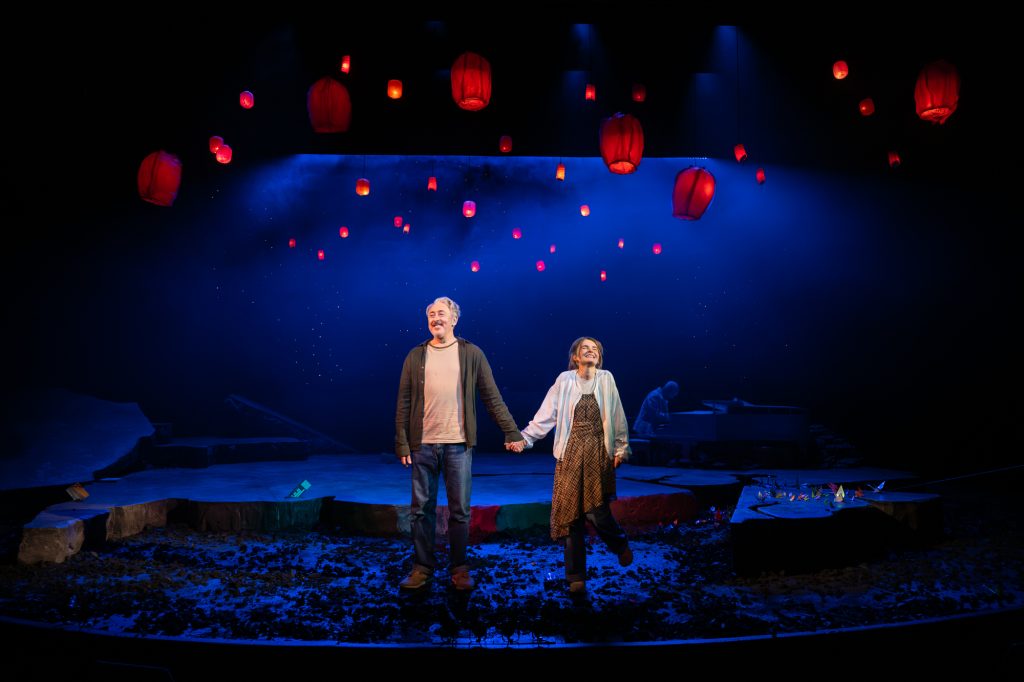
The show’s design is spectacular. What initially appears sparse gradually opens itself as a world of constant transformation, where sheets, scraps and stacks of paper hold memories as readily as words. The stage can be intimate one moment and almost magical the next, without ever overwhelming the two people at the heart of it.
It is simple. It is inventive. And it dazzles.
Heart wrenching and soaringly beautiful, A History of Paper is a reminder that the things we create with our hands can still say something machines cannot.
On his appointment as Artistic Director of Pitlochry Festival Theatre, Alan Cumming promised to “showcase the best of Scotland’s thrilling theatrical legacy”. A History of Paper ensures he lives up to that promise, while this co-production with Dundee Rep also puts two of Scotland’s leading theatre institutions firmly centre stage.
Those sensible enough to have secured tickets before much of the run sold out will be rewarded for their preparation. The Dundee Rep run is now almost totally sold out, with just a handful of tickets remaining. Those waiting for the verdict of others best move fast.
Before the rapture of hallucinating robots arrives to declare the end of creativity, A History of Paper offers hope for the future.
Perhaps the future of theatre is not paperless after all.
A History of Paper at Pitlochry Festival Theatre until 12th September, then at Dundee Rep until 19th September 2026
Production Images: Tommy Ga-Ken Wan